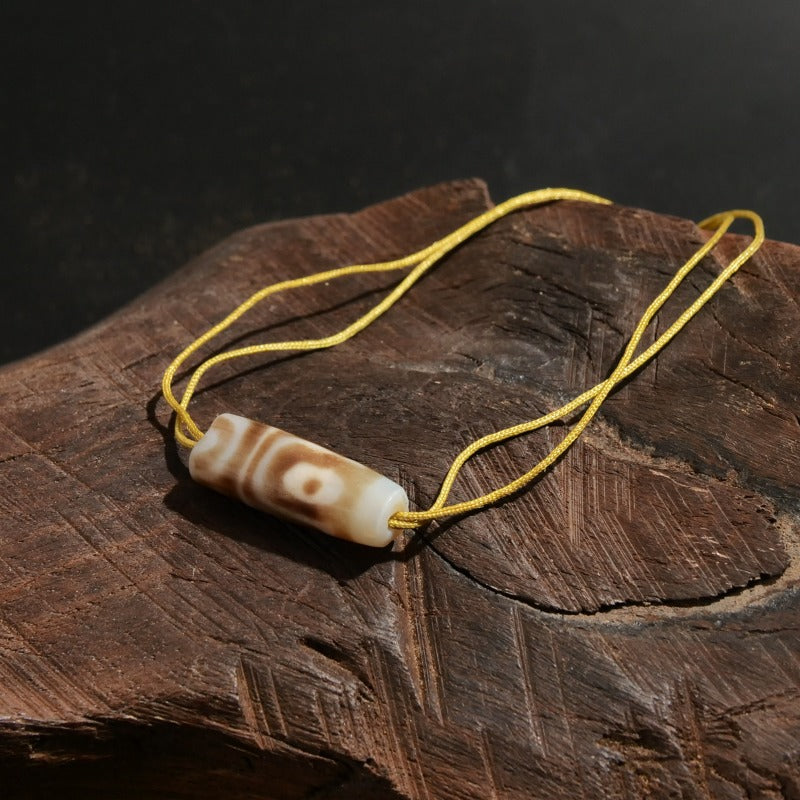
Product Description: This is a rare piece known as a "Two-Eyed Dzi Bead." Among the Dzi Beads, those featuring eye patterns are particularly valued. This bead, with its distinct eye motifs and naturally faded base color, is considered to have undergone natural weathering and extensive use over many years, enhancing its reputation as an "Old Dzi Bead." It enjoys high popularity among collectors. The bead's surface shows slight abrasions, adding to its antique charm.
Specifications:
Estimated Era of Production: Unknown
Country of Origin: Unknown
Material: Agate
Size: 2.7cm x 0.9cm
Special Notes:
As an antique item, it may have scratches, cracks, chips, or stains. Images are for illustrative purposes only, and the actual product may vary in pattern and color. Please allow for slight measurement discrepancies.
About Dzi Beads (Chongyi Beads):
Dzi Beads are ancient beads from Tibet. Similar to etched carnelians, they are designed by baking natural dyes onto agate. It is believed that they were produced around the 1st to 6th century AD. However, the components of the dyes used for baking remain largely unknown, making them one of the mysterious antique beads. Found mainly in Tibet, they have also been discovered in regions like Bhutan and Ladakh in the Himalayas. Different baked patterns are believed to have different meanings, with round "eye" patterns being particularly popular. In Tibet, they are considered "talismans of wealth and prosperity" and are cherished as heirlooms and adornments. In recent years, these beads have gained popularity in China, where they are called "Tian Zhu" (Heavenly Beads), and numerous replicas made using similar techniques are circulating. However, ancient Dzi Beads passed down through generations are extremely rare and valuable.